
Why Some SMEs Continue to Grow at pace
The Evidence Advantage
Why Some SMEs Continue to Grow at pace
While Others Struggle to Generate New Opportunities
This Paper evolved out of many years research into this topic, and has been constantly adapted as market conditions, technology and human behaviours continue to rapidly change.
Why Some SMEs Continue to Grow at pace, While Others Struggle to Generate New Opportunities.
This is an evidence-based investigation into why some businesses consistently create commercial momentum while others find growth increasingly difficult.
By Mark Stephens
Founder, BookMyDemos.com
Creator of the Marketing Intelligence Engine (MIE)
Executive Summary
If you ask a room full of business owners what has become more difficult over the last five years, most will arrive at remarkably similar answers.
Generating new business. Starting meaningful conversations. Differentiating themselves from competitors.
Cutting through the noise. Winning the attention of increasingly sceptical buyers.
At first glance, this seems like a contradiction. We have access to more marketing technology than ever before. Artificial intelligence can write content, analyse competitors, research markets, automate outreach and generate ideas in seconds. Customer data is more accessible, marketing platforms are more sophisticated, and even the smallest SME can now use tools that would have been available only to large enterprises a decade ago.
So why does growth feel harder?
This paper began with that simple question.
Rather than focusing solely on email marketing, LinkedIn outreach or the latest AI tools, it explores a broader commercial issue: why some SMEs continue to generate opportunities consistently while others, often selling comparable products into similar markets, appear to be working harder simply to stand still.
Drawing on behavioural science, commercial strategy, marketing psychology, practical business experience and the principles developed through the Marketing Intelligence Engine (MIE), this paper argues that the organisations achieving sustainable growth are not necessarily executing more marketing. They are making better commercial decisions before their marketing ever reaches the marketplace.
Throughout the paper, email and LinkedIn outreach are used as practical examples because they provide immediate and measurable feedback. Prospects respond, ignore, question or engage, making them an excellent lens through which to examine buyer behaviour. However, the principles discussed apply equally to websites, proposals, networking, webinars, content marketing, referrals, paid media and almost every other customer touchpoint.
One conclusion emerged repeatedly during the research.
The businesses creating the greatest commercial momentum have stopped thinking of marketing as a series of campaigns.
Instead, they treat marketing as a continuous process of learning.
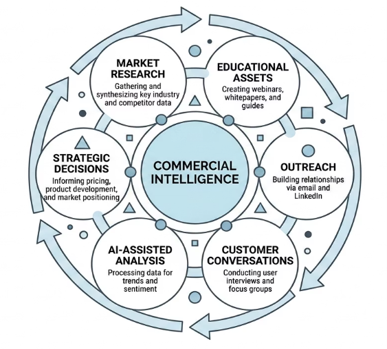
Every customer conversation becomes research.
Every campaign produces commercial intelligence.
Every objection improves future messaging.
Every piece of content strengthens the next.
Over time, this creates an advantage that competitors struggle to replicate because it is built not on technology, but on understanding.
Artificial intelligence plays an important role throughout this story, but perhaps not the one many people expect. Rather than replacing marketers, AI is becoming an extraordinarily capable research assistant, helping businesses gather evidence, identify patterns and accelerate strategic thinking. The judgement, curiosity and commercial experience required to transform that information into meaningful decisions remain fundamentally human.
Ultimately, this is not a paper about lead generation. It is a paper about decision-making.
Because before businesses improve their campaigns, they usually need to improve the thinking that shapes those campaigns in the first place.
Introduction
Over the past thirty years I've had the privilege of working with hundreds of business owners, founders and leadership teams across a wide range of industries. Some were ambitious start-ups trying to win their first major clients. Others were established SMEs looking to accelerate growth after years of steady success. A few had reached the point where almost every traditional marketing tactic appeared to be producing diminishing returns.
Despite their differences, many conversations eventually arrived at exactly the same place.
"It feels harder than it used to."
Harder to reach decision-makers. Harder to generate genuine interest. Harder to stand apart from competitors. Harder to predict where the next opportunity is coming from.
Initially, I assumed these comments reflected wider economic conditions. Rising costs, political uncertainty, cautious buyers and increasing competition all seemed perfectly reasonable explanations. They undoubtedly play a part.
But the more organisations I spoke to, the more another question began to emerge.
If everyone is facing the same market conditions, why are some businesses still growing at an impressive rate?
More importantly, what are they doing differently?
This paper is my attempt to answer that question.
Not through opinion alone, but by bringing together evidence from behavioural science, commercial psychology, strategic marketing, decades of practical experience and the work we've undertaken through the Marketing Intelligence Engine. Along the way, we'll challenge several ideas that have become accepted wisdom in modern marketing, including the belief that better technology automatically leads to better marketing, or that AI will somehow replace the need for strategic thinking.
In many ways, I hope this paper does the opposite.
My aim is to demonstrate that as technology becomes more powerful, human judgement becomes more valuable.
Because when every organisation has access to similar AI tools, similar automation platforms and similar data, competitive advantage shifts somewhere else.
It shifts back towards curiosity. Towards understanding. Towards evidence.
And towards asking better questions than your competitors.
You won't find any "magic prompts" or "five-step hacks" in the pages that follow. There are already enough articles promising those. Instead, we'll explore why the most successful SMEs are quietly adopting a different way of thinking about growth, one that treats research as a competitive advantage, marketing as a learning system and every customer interaction as an opportunity to become a little smarter than yesterday.
Some of the ideas may challenge your own assumptions. Others may simply confirm things you've instinctively felt for some time but never quite been able to articulate.
Either outcome is valuable.
Because if there's one lesson that sits above every other in this research, it's this:
The businesses that continue to grow are rarely those shouting the loudest. More often, they're the ones learning the fastest.
The rest of this paper explains why.
Chapter 1
The Growth Gap: Why Growth Feels Harder Than It Used To
For most of the last thirty years, the formula for generating new business was relatively predictable.
Build a good product.
Employ capable salespeople.
Develop a decent website.
Attend a few industry events.
Send some emails.
Advertise where your customers spend their time.
Repeat.
It wasn't perfect, but for many SMEs it was perfectly adequate.
Today, that same approach often produces very different results.
Email response rates are becoming less predictable. LinkedIn feels increasingly crowded. Buyers appear to take longer to make decisions. Trust seems harder to earn, while competition appears to arrive from every direction, often from businesses that didn't even exist a year ago.
The instinctive reaction is to blame technology.
Artificial intelligence.
Automation.
Economic uncertainty.
Remote working.
Social media.
Changing buyer behaviour.
Each of those factors has undoubtedly influenced the commercial landscape.
None of them, however, adequately explain why two businesses operating in the same market, selling similar services to similar customers, can experience dramatically different rates of growth.
That observation sits at the heart of this research.
If external conditions affect everyone, why do some businesses continue to generate opportunity while others appear to be running ever faster simply to stand still?
The answer, I believe, lies much deeper than marketing tactics.
It lies in how businesses think.
The Democratisation of Marketing
One of the greatest changes over the last decade has been the democratisation of marketing capability.
The barriers that once separated large organisations from SMEs have largely disappeared.
Ten years ago, sophisticated CRM systems, AI-powered analytics, behavioural data, automated workflows and enterprise-level research tools were available primarily to organisations with significant budgets.
Today, many of those same capabilities are available on a monthly subscription costing less than a team lunch.
Artificial intelligence has accelerated that trend dramatically. Research that once consumed several days can now be completed before your first coffee.
A first draft of a white paper can be produced in minutes. Market analysis, competitor reviews, persona development and campaign planning have all become significantly faster.
This is unquestionably good news, and it also creates an unexpected consequence.
When everybody gains access to similar tools, the tools themselves stop being a competitive advantage.
Owning Photoshop doesn't make somebody a great designer.
Buying a piano doesn't make somebody a concert pianist.
Likewise, subscribing to the latest AI platform doesn't automatically produce better marketing.
Technology has democratised execution.
But it has not democratised judgement.
That distinction may prove to be one of the defining commercial realities of the next decade.
The Attention Economy
If technology is no longer the scarce resource, what is?
Attention.
Every organisation now has the ability to publish.
To advertise. To automate. To personalise. To create video. To write articles. To launch podcasts. To build newsletters. To generate email campaigns. To post daily on LinkedIn.
Unfortunately, so does everyone else. And the consequence is not simply more competition. Its an explosion in commercial noise.
Your prospective customers aren't comparing your latest email with the one sent by your nearest competitor. No. they're comparing it with every other message competing for their attention that morning.
Internal meetings. Customer enquiries. Slack notifications. WhatsApp messages. Industry newsletters. LinkedIn updates. Supplier emails. Breaking news. Calendar reminders. Family messages. The list goes on
Somewhere within that extraordinary stream of information sits your carefully crafted outreach email.
It isn't competing against another email, it's competing against life itself.
That changes everything, because the challenge is no longer creating content. The challenge is creating something sufficiently relevant that another human being voluntarily chooses to invest their limited attention in it.
Attention has quietly become one of the world's most valuable commercial currencies.
Buyers Have Changed More Than Sellers
Many discussions about marketing focus on what businesses should do differently.
Far fewer examine how buyers themselves have evolved.
Today's decision-makers are extraordinarily well informed.
Before speaking to a supplier they have often: Visited the website, read independent reviews, compared competitors, watched product demonstrations, asked peers for recommendations, read LinkedIn profiles, used AI to summarise available information, downloaded reports and read customer testimonials.
By the time a sales conversation begins, a significant proportion of the buying journey has often already taken place.
That changes the role of marketing completely.Businesses can no longer rely on being the primary source of information.Instead, they must become the most useful interpreter of information.
The winners in this new world def aren't those saying the most. They're those helping buyers make sense of increasingly complex decisions.
That is a very different commercial role.
The Productivity Trap
Whenever growth slows, businesses usually respond in predictable ways.
Send more emails.
Increase advertising.
Attend another exhibition.
Publish more content.
Buy more data.
Invest in another AI platform.
None of those decisions are inherently wrong.In fact, many are sensible. The problem begins when increased activity becomes a substitute for improved understanding.
I've seen organisations double the number of outbound emails while leaving the underlying strategy untouched.
Guess what - The result is almost always predictable. Twice the activity and roughly the same outcome. It's rather like trying to improve your aim by buying more arrows. Eventually, someone has to ask whether the problem is actually the target.
This is where many SMEs unknowingly enter what I describe as the Productivity Trap.
They become exceptionally efficient at repeating assumptions, and artificial intelligence can make that trap even more dangerous, because it enables organisations to execute average thinking at remarkable speed. Which raises an uncomfortable possibility.
Perhaps AI isn't amplifying the quality of marketing.
Perhaps it's amplifying the quality of thinking behind the marketing.
Good strategy improves faster. Poor strategy simply scales more quickly.
From Activity to Understanding
One pattern appeared repeatedly throughout this research.The organisations growing most consistently weren't doing more marketing, they were spending significantly more time understanding the environment in which their marketing operated.
Research wasn't an occasional project anymore. It has become part of their everyday business.
Customer interviews.
Competitive analysis.
Win-loss reviews.
Market trends.
Commercial intelligence.
Behavioural insights.
Every campaign contributed knowledge, and every conversation improved understanding. Marketing gradually became a by-product of learning rather than a replacement for it.
That subtle shift changes almost every commercial decision that follows.
Because once understanding becomes the objective, better marketing becomes an inevitable consequence.
Not the other way around.
The Emerging Divide
Looking ahead, I believe the gap between high-growth and low-growth SMEs will continue widening. Not because larger businesses possess more resources.Nor because AI will replace smaller competitors. The divide will emerge for a much simpler reason.
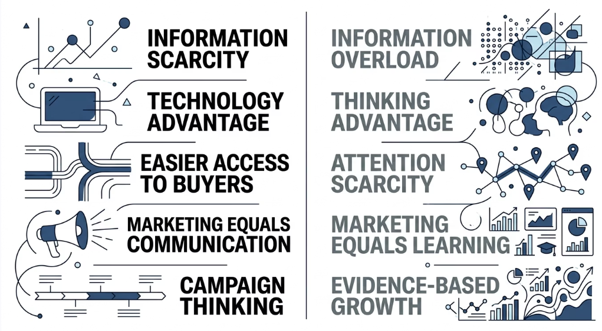
Some organisations will use technology primarily to produce more marketing, while others will use technology to become smarter organisations.
Only one of those approaches compounds over time.
Only one creates genuine competitive advantage.
And only one consistently improves every future commercial decision.
That is where this research now turns.
Because if high-growth businesses really are thinking differently, the obvious question becomes...
What exactly are they doing that everyone else isn't?
Recommended Reading
Rita McGrath – Seeing Around Corners
https://www.ritamcgrath.com/
A compelling exploration of why organisations must continually detect and respond to weak signals in changing markets, rather than relying on past success.
Thomas H. Davenport & Nitin Mittal – All In on AI
https://hbr.org/
A practical look at how organisations are creating competitive advantage through AI by improving decision-making and organisational capability, rather than simply automating existing processes.
Chapter 2
The Seven Behaviours That Separate High-Growth SMEs From Everyone Else
One of the biggest surprises from this research was not discovering that successful businesses market differently, it was discovering that they think differently.
Spend enough time with high-growth organisations and you quickly realise they don't possess some secret marketing playbook hidden from everyone else. They're not using mysterious AI prompts or obscure LinkedIn techniques that nobody else has discovered. In many cases, they're using exactly the same technology as their competitors, and in many enterprise organisations .
The difference lies in what happens before they launch a campaign.
Over time, seven consistent commercial behaviours began appearing again and again. Individually, none of them feels revolutionary. Collectively, they create an organisation that becomes progressively more difficult to compete against.
Interestingly, none of these behaviours are actually about email or LinkedIn.
They're about building a business that understands its market so well that every marketing channel becomes more effective.
Email simply makes that difference easier to observe.
They Research Markets Before They Target Markets
Average businesses begin with a database. But High-growth businesses begin with a bunch of questions.
What's changing?
What pressures are our customers under?
What conversations are happening inside their organisations that weren't happening six months ago?
What assumptions are our competitors making?
More importantly, are they still true?
It's remarkable how many marketing strategies begin without anyone asking these questions.
Instead, the process often starts with buying data, choosing a sector, identifying job titles and asking AI to produce an outreach campaign.
Technically, that's marketing - Strategically, it's guessing.
The organisations consistently generating opportunities tend to reverse that sequence.
Research comes first. The campaign comes later.
But that sounds obvious doesnt it?. Unfortunately, obvious isn't always common practice.
One of the most successful outbound campaigns we ever developed didn't begin with writing emails.It began with almost three weeks of reading annual reports, analysing industry trends, interviewing customers and identifying recurring commercial frustrations.
By the time we eventually sat down to write the first email, most of the difficult thinking had already been done.
In fact, the copy almost wrote itself.'
That's usually a sign that the research has been worthwhile.
They Create Assets, Not Just Campaigns
This may be the single biggest difference I've observed over the past decade.
Average businesses build campaigns.
High-growth businesses build assets.
The distinction is subtle. A campaign has an expiry date. An asset appreciates.
Think about the average email campaign. Once it's finished, what remains?
Perhaps a spreadsheet. A few analytics. Some lessons that are quietly forgotten by the next campaign.
Now compare that with producing an industry benchmark report.
A practical framework.
An executive briefing.
An assessment tool.
A commercial calculator.
A maturity model.
Those assets continue creating value long after the original campaign has ended.
They strengthen sales meetings, support proposals, improve LinkedIn content, generate PR opportunities.
They also provide material for webinars, help qualify prospects, educate customers, support recruitment and strengthen partnerships.
In other words, they become part of the business rather than simply part of the marketing department.
This is one of the fundamental ideas underpinning the Marketing Intelligence Engine (our most comprehensive research to date. 1500+ pages of marketing analysis).
Every significant piece of work should leave something behind that makes the organisation more capable than it was before. And definitely not just busier.
Marketing Assets that Teach Before They Sell
Think back to the last piece of marketing you genuinely enjoyed reading. The chances are it didn't feel like marketing at all. It probably helped you understand something. And perhaps it challenged an assumption or explained a trend or provided a useful framework.
Or it simply articulated a problem you'd been struggling to define yourself.
That's education, and education has quietly become one of the most commercially powerful forms of marketing available. Not because people enjoy being taught, but because people trust organisations that consistently help them think more clearly.
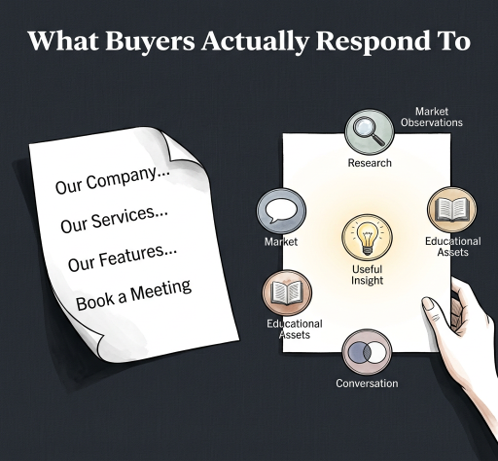
The best outreach campaigns rarely begin with,"Here's what we do."
They begin with, "We've noticed something happening in your market..."
One introduces a supplier. The other introduces an idea.
Ideas travel much further than products.
They Treat Every Customer Conversation As Research
One question I often ask clients is surprisingly simple: "Where does customer knowledge live inside your business?"
The answers are fascinating. Usually somewhere between..."Mostly in the sales team's heads..." and..."It's all in the CRM somewhere..."
Neither is particularly reassuring.
Every customer conversation contains commercial intelligence.
Questions. Objections. Concerns. Language. Buying behaviour. Decision-making processes. Competitive comparisons.
The highest-performing businesses don't simply record those conversations. They mine them.
Patterns begin to emerge. Certain objections appear repeatedly. Specific phrases consistently resonate.
And particular industries raise similar concerns.
Eventually, the organisation develops something remarkably valuable. Evidence -Not assumptions.
That evidence steadily improves every future campaign.
They Use AI To Improve Judgement, Not Replace It
Whenever AI is discussed, the conversation tends to become strangely polarised.
Either it's about to replace every marketer on the planet, or it's nothing more than an overhyped writing assistant.
Personally, I think both positions underestimate what's actually happening, because the greatest value AI brings isn't writing. It's understanding.
It helps identify patterns humans might overlook, and it summarises vast quantities of information.
It compares markets, reviews competitors, highlights emerging themes, challenges assumptions and it accelerates analysis.
Notice something interesting there.
None of those activities removes the need for judgement.
They simply provide better material upon which judgement can operate, and that's a very different proposition.
Throughout the development of the Marketing Intelligence Engine we've consistently worked from one central belief. AI should make marketers more intelligent - Not unnecessary.
That distinction runs through every strategy we've developed.
Build Systems Instead Of Activities
Many SMEs still organise marketing around isolated events.
An exhibition.
A campaign.
A webinar.
A white paper.
Some social media.
Then on to the next thing.
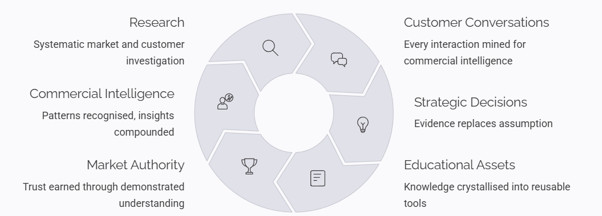
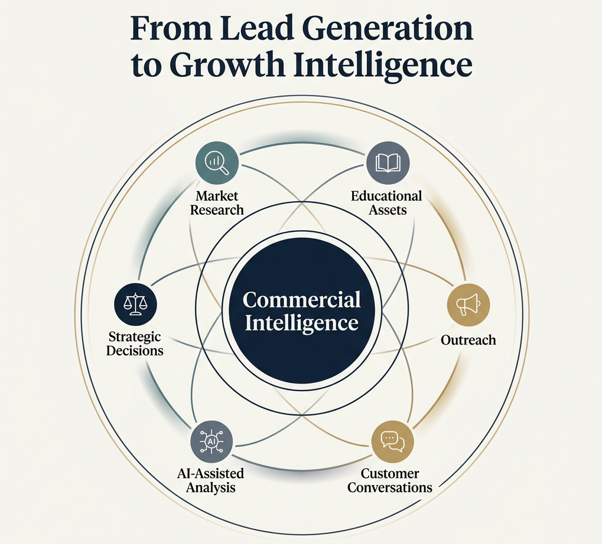
The best businesses build connected systems, research informs content and content supports outreach.
Outreach generates conversations, conversations create intelligence, and intelligence improves research.
Everything strengthens everything else.
That's an entirely different way of thinking.
Instead of asking, "What's our next marketing campaign?" they ask, "How does this make our entire commercial system better?"
Those are profoundly different conversations.
One produces activity, while the other produces capability.
Compounding Knowledge
If I had to reduce this entire paper to one concept, it would probably be this.
Knowledge compounds.
Most people immediately think of compound interest when they hear that word, and marketing behaves remarkably similarly.
Every useful customer conversation.
Every industry report.
Every lost proposal.
Every successful campaign.
Every objection.
Every assessment completed.
Every research paper published.
Each one contributes a tiny amount of additional understanding.
On its own, almost insignificant, but collectively, transformative.
Eventually, competitors and customers begin noticing something. Your messaging becomes unusually relevant.
Your website appears to answer questions before prospects ask them, and sales conversations become shorter.
Trust develops more quickly. Not because your marketing team became more creative, but because your organisation became more knowledgeable.
That is an advantage that becomes stronger over time. It's Never Really Been About Marketing
Looking back across all seven behaviours, one thing becomes difficult to ignore. None of them are really marketing behaviours. They're organisational behaviours. They're habits. They are ways of making decisions, ways of learning, ways of interpreting evidence.
Marketing simply becomes the outward expression of those habits.
Perhaps that's why some organisations appear to possess an almost unfair commercial advantage.
They aren't necessarily better marketers. They're just better learners.
And once you begin looking at successful businesses through that lens, many of their decisions suddenly make perfect sense.
Research isn't a cost. It's an investment.
Content isn't promotion. It's education.
Outreach isn't interruption. It's the beginning of a conversation.
AI isn't replacing expertise. It's helping expertise scale.
That is a very different philosophy from traditional lead generation, and it naturally raises another question.
If these behaviours create better commercial outcomes, how do they fit together into a practical operating model that any SME can realistically adopt?
And that's where we go to next.
Recommended Reading
Jim Collins – Good to Great
https://www.jimcollins.com/
Still one of the most insightful studies into why some organisations consistently outperform others, not through isolated tactics but through disciplined behaviours that compound over time.
David Epstein – Range: Why Generalists Triumph in a Specialized World
https://davidepstein.com/
A fascinating exploration of why organisations and individuals who draw insight from multiple disciplines often make better long-term strategic decisions.
Chapter 3
The Businesses Pulling Away Aren't Doing More Marketing. They're Learning Faster.
One of the questions I've been asking myself throughout this research is whether successful SMEs really are doing something radically different, or whether they're simply doing the same things slightly better.
Initially, I assumed the answer would be found somewhere in the marketing. Better email campaigns. Smarter use of LinkedIn. More sophisticated AI. Better targeting. More automation. It seemed like the obvious place to look because that's where most of the conversation is happening at the moment.
The more businesses I looked at, however, the less convinced I became that marketing was the real differentiator.
Here's why.
Spend a day with two companies operating in the same market and, on the surface, they often look remarkably similar. They'll probably be using the same CRM, have access to the same AI tools, attend the same exhibitions and employ people with comparable levels of experience. They may even be targeting the same prospects with similar products at similar price points.
Yet one business continues generating opportunities whilst the other seems permanently frustrated that "marketing isn't working anymore".
That difference fascinated me.
Because if they're playing on the same pitch, using much the same equipment, surely the explanation must lie somewhere else.
I think it does.
Over the years I've become increasingly convinced that the businesses creating sustainable growth aren't necessarily better marketers. They're better learners. That may sound like semantics, but I don't think it is. In fact, I think it explains almost everything we've discussed so far.
When most organisations finish an email campaign, they measure the obvious things. Open rates, reply rates, meetings booked, pipeline generated. All perfectly sensible metrics. The campaign ends, someone presents a few graphs in the monthly meeting, lessons are discussed briefly and then everyone moves on to planning the next campaign.
Now compare that with a business that approaches exactly the same campaign slightly differently.
Yes, they still look at reply rates and meetings generated, but they're far more interested in understanding why people responded in the first place. Which industries engaged most? Which assumptions turned out to be wrong? What language did prospects naturally use during follow-up conversations? Were buyers actually interested in the service being promoted, or was it the research paper attached to the email that started the discussion?
It doesn't sound dramatically different.
Guess what? Six months later it isn't dramatically different.
Two years later and it's a completely different business.
That's the thing about knowledge. It compounds quietly. You don't notice it building from one week to the next, but eventually you look back and realise your understanding of the market bears very little resemblance to where it was a few years earlier.
I sometimes think we've become a little obsessed with the idea of compounding when it comes to finance, yet we rarely talk about it in relation to commercial knowledge. Every business owner understands the principle of compound interest. Leave your money invested for long enough and eventually the returns begin generating returns of their own.
Customer understanding behaves in exactly the same way.
One customer interview probably won't transform your business. Neither will one survey or one successful campaign. But interview fifty customers over the course of two years and patterns begin emerging that simply weren't visible before. Write down every objection raised during sales meetings and you'll eventually discover that most prospects aren't actually asking fifty different questions. They're asking the same six or seven questions in slightly different ways. Analyse enough lost opportunities and you'll often discover they weren't really lost because of price at all. Price was simply the easiest explanation to give. The real reasons were usually much more interesting.
That sounds obvious, doesn't it?
Yet very few businesses systematically capture that knowledge.
Instead, it remains scattered across notebooks, CRM records, meeting minutes and people's memories. Some of it disappears when employees leave. Some of it sits in folders that nobody opens again. Some of it simply fades away because the next urgent project arrives before anyone has time to reflect on the last one.
I've always thought that's an extraordinary waste.
Imagine if an engineer solved the same problem every six months because nobody documented the solution the first time. Or if a surgeon forgot everything they learned after each operation. We'd think that was absurd.
Yet businesses do something remarkably similar with customer knowledge every day.
Perhaps that's one of the reasons growth becomes harder.
Not because markets become more competitive, although they undoubtedly do. Not because buyers become more difficult, although they probably have. But because organisations repeatedly pay to learn the same lessons without ever turning those lessons into an asset.
The businesses pulling away seem to have recognised this.
Research isn't treated as something you do before launching a campaign. It's something that's happening all the time. Customer conversations become research. LinkedIn discussions become research. Sales meetings become research. Every proposal, every lost opportunity and every successful implementation adds another piece to the puzzle.
Eventually marketing begins feeling different.
Instead of sitting in front of a blank screen wondering what to write, the business already has a long list of genuine observations worth sharing. Instead of asking AI to invent thought leadership, they're asking it to help organise, challenge and expand ideas that already exist.
That's a completely different relationship with technology.
I sometimes worry that we've become distracted by AI's ability to produce content. It's impressive, but I don't think it's the biggest opportunity. The real opportunity is that, for the first time, SMEs have access to tools that help them organise decades of accumulated commercial experience into something they can actually use.
That's a profound shift.
Large consultancies have always had institutional knowledge. They built libraries of methodologies, research, frameworks and case studies over decades. Smaller businesses often relied on one or two experienced people carrying most of that knowledge around in their heads.
AI changes that equation.
It gives SMEs the opportunity to build organisational memory rather than individual memory. The expertise still comes from people. AI simply makes it easier to preserve, connect and retrieve it.
Which perhaps explains why I remain optimistic about where marketing is heading.
Not because I think AI will replace marketers. In fact, quite the opposite.
I think it will expose the difference between businesses that simply create more content and those that genuinely understand their customers.
One group will become more efficient. The other will become more intelligent.
Personally, I know which one I'd rather compete against.
Chapter 4
Why Most Cold Outreach Fails (And Why It Isn't Really About Email)
Here's something I've noticed over the years.
Whenever an outreach campaign underperforms, the immediate reaction is nearly always to blame the email.
We rewrite the subject line, tweak the opening paragraph, add another follow-up and perhaps even move to a different platform. Sometimes we blame LinkedIn, sometimes we blame deliverability and, increasingly, we blame AI. It's almost become the default response. Something didn't work, therefore something must be wrong with the message.
But here's the interesting part.
By the time someone receives your email, almost every important marketing decision has already been made. The email is simply where the prospect gets to see the end result of all the thinking that happened beforehand.
If the research was weak, the positioning is unclear and the business doesn't genuinely understand the challenges its audience is facing, the email faithfully reflects every one of those shortcomings. In many respects it isn't creating the problem at all. It's simply exposing it.
That may sound like a slightly uncomfortable observation, but I actually find it encouraging because it changes where we go looking for the solution.
Instead of endlessly optimising copy, we start improving the thinking that produced the copy in the first place.
And that's a much more interesting conversation.
I was working with a software company recently that had become convinced email no longer worked.
Their response rates had fallen dramatically over the previous eighteen months and, understandably, everyone had started looking for technical explanations. Was it spam filtering? Had AI flooded inboxes? Were prospects simply overwhelmed? Should they move their budget into paid advertising instead?
They're all perfectly reasonable questions.
But before changing anything, we sat down and looked at every campaign they'd sent over the previous year.
Not the open rates. Not the click rates. The actual emails.
Something became obvious almost immediately. Every campaign was talking about the company.
Their platform. Their features. Their implementation. Their experience. Their customers.
There was almost nothing about the world the prospect was currently operating in.
The emails weren't badly written. Far from it.
In fact, they were probably better written than most of the emails arriving in their customers' inboxes.
They were simply answering questions that nobody was asking yet.
Once we reframed the conversation around the commercial pressures their buyers were experiencing, everything changed. The software itself barely featured in the opening emails. Instead, we talked about changing customer expectations, the operational challenges we'd uncovered through our research and some interesting patterns emerging across their industry.
The reply rates increased. Not dramatically overnight. But steadily.
More importantly, the conversations that followed were completely different.
Prospects weren't asking for demonstrations. They were asking questions.
That's a subtle difference, but an incredibly important one.
Questions signal curiosity. Demonstration requests often signal evaluation.
I'd much rather start with curiosity.
That brings me to another observation.
I think we've become slightly obsessed with personalisation.
Ask most marketers how they personalise an email and they'll start talking about first names, company names, recent LinkedIn posts or perhaps mentioning an award the prospect won a few weeks ago.
None of those things are wrong. They're just not particularly memorable anymore.
Think about your own inbox. How many emails begin with something like,
"I noticed your recent post..."
or,
"Congratulations on your latest funding round..."
The first few probably felt thoughtful. By the twentieth one they simply became another formula.
The problem isn't that they're personalised. The problem is that they're personalised in exactly the same way as everybody else's.
Real personalisation has very little to do with mentioning somebody's name.
It's about demonstrating that you understand the commercial implications of what's happening inside their business. There's quite a difference between saying,
"Congratulations on opening your new office in Birmingham."
and saying,
"One of the things we've consistently observed when businesses expand geographically is that demand generation suddenly becomes far more difficult because the messaging that worked brilliantly in one region often performs very differently somewhere else."
One sentence proves you've looked at their website.
The other suggests you've spent time understanding businesses like theirs.
Guess which one usually starts a better conversation.
I also think we've misunderstood what buyers actually want from outreach.
Contrary to what some marketing experts might have you believe, people aren't fundamentally opposed to receiving unsolicited emails.
They're opposed to receiving irrelevant ones.
There's an important difference.
I've received cold emails that have genuinely made me stop and think. Not because they were beautifully written.And not because they contained some clever psychological trigger. But, because the sender had clearly uncovered something interesting.
Sometimes it was research. Sometimes it was an observation.
Occasionally it was simply a question I'd never really considered before.
You see, good outreach doesn't interrupt somebody's day. It improves it. And that should probably become the benchmark. Before any campaign leaves your business, ask one simple question.
"If I received this email tomorrow morning, would I actually be pleased that somebody had sent it?"
Not because they were asking for a meeting. But, because I'd learned something.
That's a surprisingly high standard, and it's also the standard your prospects quietly apply every day.
There's another reason I think so many outreach campaigns struggle.
Most businesses expect far too much from a single email.
They try to introduce the company, explain the service, establish credibility, differentiate themselves from competitors, communicate value, overcome objections and ask for a meeting, all within about two hundred words.
It's hardly surprising the message ends up feeling crowded.
Imagine walking into a networking event and trying to achieve all of that within the first thirty seconds of meeting someone.
It would feel awkward.
Yet that's exactly what many outbound campaigns attempt to do.
I've gradually come to the conclusion that the purpose of a cold email isn't actually to sell anything.
Its job is much simpler than that.
It's to start a conversation worth continuing.
Everything else can happen later.
That's why educational assets have become such an important part of our own approach.
Research papers.
Benchmark reports.
Interactive assessments.
Executive briefings.
Decision-making frameworks.
None of them exist because people enjoy downloading PDFs.
They exist because they allow the conversation to continue naturally.
Instead of asking someone to trust us because we say we're experts, we're giving them the opportunity to judge the quality of our thinking for themselves.
Those are two very different propositions.
This is also where I think AI has been both a blessing and a curse. It has made it incredibly easy to create competent marketing. And that's exactly the problem.
Competent has become the new average.
Anyone can now produce a reasonable email sequence in a matter of minutes. AI will happily write subject lines, suggest follow-ups and even adjust the tone depending on the audience.
Useful? Absolutely.
Differentiating? Not particularly.
The competitive advantage no longer comes from asking AI to write an email. It comes from giving AI something genuinely original to work with.
Original customer research. Original market observations. Original thinking. The irony is that AI is making human curiosity more valuable, not less.
Because whilst AI is exceptional at recognising patterns, it still relies on somebody asking interesting questions in the first place.
That's why I don't believe AI will replace marketers.
I think it will gradually expose the difference between marketers who rely on information and marketers who generate insight.
Those are very different capabilities.
Looking back, I'm not convinced this chapter has really been about email at all.
It's been about something much broader.
Cold outreach is simply one of the quickest ways of discovering whether your business genuinely understands its market.
The inbox is remarkably honest.
It doesn't care how much effort went into the campaign. It doesn't care how many meetings your team had beforehand. And it doesn't care how impressive your CRM looks or how sophisticated your automation platform has become.
It simply reflects the quality of the thinking behind the message.
Perhaps that's why I still like outbound marketing so much after all these years.
It's unforgiving. But it's fair.
If your business has something genuinely useful to say, grounded in evidence and delivered with an understanding of the challenges your audience is facing, people will usually reward you with something incredibly valuable.
Their attention.
And in today's marketplace, that's probably where every commercial relationship still begins.
Recommended Reading
April Dunford – Obviously Awesome
https://www.aprildunford.com/
An excellent book on positioning that reinforces the idea that successful marketing is usually determined long before the first campaign is written.
Matthew Dixon & Brent Adamson – The Challenger Sale
https://www.penguinrandomhouse.com/books/215017/the-challenger-sale-by-matthew-dixon-and-brent-adamson/
Particularly relevant for anyone interested in replacing product-led conversations with commercially valuable insights that earn attention before asking for commitment.
Chapter 5
From Lead Generation to Growth Intelligence
I don't think there's anything wrong with measuring leads.
Let's get that out of the way first.
Every business needs opportunities. Sales teams need conversations. Directors need pipeline reports. Cash flow is still driven by customers saying "yes", not by beautifully written strategy documents.
The problem begins when lead generation becomes the objective rather than the outcome.
That might sound like semantics, but I don't think it is.
Over the years I've worked with businesses that became almost obsessed with producing more leads. Every marketing meeting eventually drifted back to the same conversation. How many enquiries did we generate? Which campaign performed best? Which channel produced the lowest cost per acquisition? Could we squeeze another percentage point out of the conversion rate?
They're perfectly sensible questions, and every marketing department should be asking them.
The trouble is they aren't the first questions I'd be asking.
I'm much more interested in understanding whether the business knows more about its market today than it did six months ago.
That sounds like an odd thing to measure, doesn't it?
Stay with me.
Think about the businesses you admire most.
Not necessarily the biggest businesses, but the ones that always seem to be one step ahead of everyone else.
They have an annoying habit of publishing something useful just as the rest of the market begins talking about it. They seem to understand where customers are struggling before everyone else does. Their webinars feel relevant, their articles feel timely and when you eventually speak to them, you get the impression they've already spent months thinking about the problem you're only just beginning to wrestle with.
It's tempting to assume they're simply better marketers.
Personally, I don't think they are.
I think they're better listeners.
Somewhere inside those organisations, somebody is constantly joining the dots.
Sales conversations are being analysed rather than simply recorded. Customer interviews are feeding into future messaging. Lost opportunities aren't filed away under "unsuccessful"; they're treated as another opportunity to understand how buyers think. Even support tickets become useful because they reveal where customers continue to struggle after they've bought the product.
Individually, none of those activities looks particularly exciting.
Collectively, they create something that's incredibly difficult to compete with.
They create organisational memory.
Here's another observation I've made over the years.
Ask most businesses what their greatest asset is and you'll hear the usual answers.
"Our people."
"Our customers."
"Our reputation."
"Our technology."
All true.
Very few ever say, "Our accumulated understanding."
Yet I suspect that's exactly what separates many high-growth businesses from everyone else.
Imagine taking away a company's CRM tomorrow morning. Painful, but recoverable.
Take away the website. Inconvenient, but it can be rebuilt.
Now imagine taking away everything the organisation has learned over the last ten years about its customers. Every insight from sales meetings. Every lesson from successful projects. Every objection that was overcome. Every pattern hidden inside customer feedback.
That would be catastrophic. Because you'd still have the business. You just wouldn't know nearly as much about the people you were trying to serve.
The irony is that many organisations allow exactly that to happen without realising it.
Knowledge remains trapped inside individual people.
When experienced employees leave, years of commercial understanding quietly leave with them.
New employees unknowingly repeat mistakes that were solved years earlier.
The same conversations happen again and again because nobody ever turned those conversations into something reusable.
I've always thought that's one of the biggest missed opportunities in business.
Perhaps this is where AI genuinely changes the game.
Not because it can write another LinkedIn post.
If I'm honest, I think we're already becoming rather bored of those.
The real opportunity is that AI gives smaller organisations something they've never realistically had before.
The ability to organise knowledge.
Think about how many conversations happen inside a typical SME during a year.
Sales calls. Project meetings. Customer reviews. Networking events. Webinars. Support tickets. Proposal discussions. Recruitment interviews. Supplier meetings.
Now imagine if every one of those conversations could quietly contribute towards making the organisation just a little bit smarter.
Not through endless reports that nobody reads.
Through patterns.
Connections.
Recurring themes.
Questions that keep appearing.
Problems that refuse to go away.
Emerging opportunities that weren't obvious six months earlier.
That's where I think AI becomes genuinely exciting.
Not because it replaces human expertise.
Because it helps us make much better use of the expertise we already possess.
The more I think about it, the more I believe we've been using the wrong language for years.
We talk about building marketing campaigns. But perhaps we should be talking about building commercial assets instead.
A campaign has a beginning and an end.
You launch it.
You measure it.
You move on.
An asset behaves differently.
A good research paper keeps creating conversations long after the campaign that introduced it has finished. A practical framework becomes part of proposals, workshops and board meetings. An assessment tool helps prospects understand their own challenges before they've even spoken to you.
The list goes on. Eventually you realise something rather interesting.
You're no longer creating content to support marketing.
You're creating intellectual property that supports the whole business.
Sales use it.
Marketing use it.
Leadership use it.
Partners use it.
Customers use it.
Even recruitment becomes easier because prospective employees can see the quality of thinking inside the organisation before they've joined.
That's a very different investment from writing another sequence of emails.
This is probably a good point to clarify something.
Throughout this paper I've deliberately argued that businesses should educate before they sell.
Some people interpret that as giving away too much.
I've never really understood that concern.
Reading a research paper doesn't implement a growth strategy.
Downloading a framework doesn't transform a business.
Knowing what needs to be done and actually doing it have always been two very different things.
Think about it another way. There are thousands of excellent books on leadership.
But that hasn't eliminated the need for good leadership consultants.
There are countless books about fitness. Personal trainers still seem remarkably busy.
The availability of knowledge has never reduced the value of expertise.
If anything, it's increased it.
Because once people understand the complexity of the challenge, they often become more willing to seek experienced guidance rather than less.
That's certainly been my experience.
So perhaps the biggest shift isn't from traditional marketing to digital marketing.
Or from outbound to inbound. Or even from human intelligence to artificial intelligence.
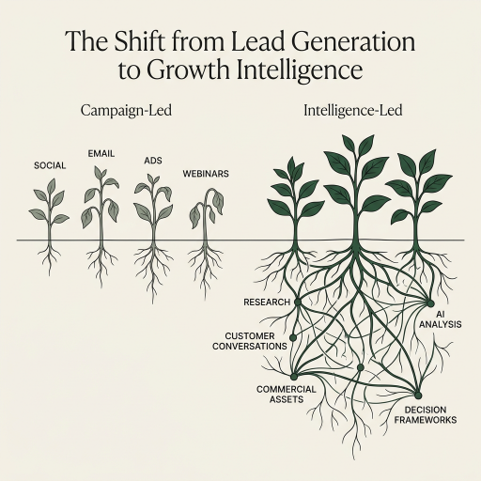
Perhaps the real shift is from businesses that generate marketing activity to businesses that continuously generate commercial intelligence.
One approach creates campaigns. The other creates capability.
One resets every quarter. The other compounds every month.
One relies on producing more. The other relies on understanding more.
If this research has convinced me of anything, it's that the second approach is becoming one of the few competitive advantages that technology alone cannot replicate.
And perhaps that's the most encouraging conclusion of all.
Because whilst every business can buy the same software, nobody can buy ten years of accumulated understanding about their customers.
That still has to be earned.
By now, the shape of the argument should be becoming clearer.
Growth isn't really the result of better emails, better LinkedIn posts or better AI prompts.
Those things certainly help.
But they're simply outputs.
The businesses continuing to pull away from their competitors have quietly built something much more valuable underneath.
A system that turns every campaign into learning, every customer conversation into evidence and every piece of evidence into better commercial decisions.
The obvious question now is how an SME actually builds that kind of capability without employing a research department or spending millions on technology.
Fortunately, it's considerably simpler than many people imagine.
That's where we'll turn next.
Recommended Reading
Peter M. Senge – The Fifth Discipline
https://www.penguinrandomhouse.com/books/160124/the-fifth-discipline-by-peter-m-senge/
Still one of the best books ever written on why organisations that continuously learn ultimately outperform those that simply execute more efficiently.
Ikujiro Nonaka & Hirotaka Takeuchi – The Knowledge-Creating Company
https://global.oup.com/
A landmark work exploring how organisations create, capture and apply knowledge to build long-term competitive advantage.
Chapter 6
Building an Evidence-Based Growth Strategy
At some point in almost every consultancy project, somebody will ask me a question that sounds perfectly reasonable.
"So, where do we start?"
On the face of it, it's exactly the right question. They've read the research, agreed with many of the observations and accepted that marketing has changed. They're now looking for a practical starting point.
The answer they expect is usually something tactical.
Should we improve the website?
Rewrite our email sequence?
Produce more content?
Invest in LinkedIn?
Buy a new CRM?
Use AI more effectively?
The trouble is, I've learned over the years that jumping straight to tactics is a little like prescribing medication before you've diagnosed the patient. Sometimes you get lucky. More often, you simply end up treating the symptoms whilst the real issue quietly continues underneath.
That's why my answer is almost always the same.
"We start by understanding the business."
Not the marketing.
The business.
That occasionally surprises people because they assume they've hired me to help with marketing. In reality, marketing is usually the last thing we discuss.
Instead, I want to understand where the business is trying to get to over the next three or five years. I want to know which clients they most enjoy working with, which projects generate the best margins, which customers stay longest, which ones become advocates and, just as importantly, which opportunities they wish they'd never won in the first place.
Those conversations tell you far more about a company's future than looking at its Google Analytics account ever will.
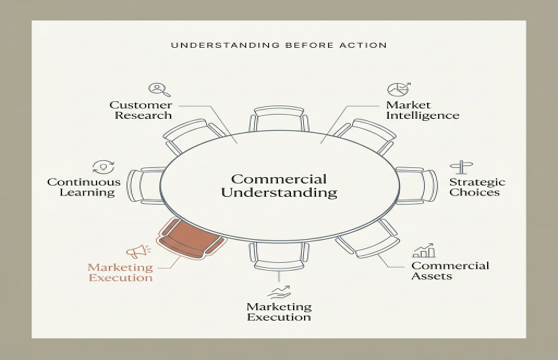
Marketing doesn't exist in isolation.
It amplifies whatever already exists inside the business.
If your positioning is weak, marketing amplifies confusion.
If your customer proposition is compelling, marketing amplifies clarity.
If your leadership team can't agree who your ideal customer actually is, marketing simply amplifies inconsistency.
That's why I often say that marketing is one of the most honest functions in any organisation.
It reflects the quality of the thinking behind it.
Here's an exercise I sometimes use during strategy workshops.
I ask the leadership team to imagine that, somehow, we'd managed to double the number of enquiries arriving every month.
At first everyone smiles.
After all, that's what we're aiming for, isn't it?
Then I ask the obvious follow-up question.
"What happens next?"
The room usually goes quiet.
Someone mentions recruiting another salesperson.
Operations point out they'd struggle to deliver the additional work.
Finance starts talking about cash flow.
Customer Success worries about onboarding.
Someone else quietly admits they don't think the current sales process would convert twice as many enquiries anyway.
Within a few minutes we've stopped talking about marketing completely.
We're talking about the business.
That's exactly where strategy belongs.
Because growth isn't simply about creating more opportunities.
It's about creating an organisation that's capable of benefiting from those opportunities when they arrive.
Another thing I've noticed is that businesses have an unfortunate habit of falling in love with solutions before they've properly understood the problem.
Every few years the industry becomes fascinated by something new.
Marketing automation.
Account Based Marketing.
Social selling.
Conversational marketing.
Artificial intelligence.
Now, before anyone berates me, let me be clear.
I'm not criticising any of those things. We've used every one of them. Some have transformed the way we work.
The problem begins when businesses assume the latest solution automatically solves their biggest challenge.
Technology doesn't replace strategy. It magnifies it.
Good thinking usually becomes better. Poor thinking simply becomes faster.
I sometimes think AI has accidentally demonstrated this more clearly than anything else. Two businesses can ask exactly the same AI platform to produce an outreach campaign.
One generates something genuinely insightful. The other produces six perfectly acceptable emails that sound remarkably similar to everyone else's.
The difference wasn't the technology.
It was the quality of the thinking that went into the prompt.
Which, if you think about it, has always been true.
Perhaps this is why I'm slightly uncomfortable whenever somebody asks for "the perfect marketing strategy." – Because - There isn't one.
There are simply better questions.
Who are we genuinely trying to help?
What has changed in their world over the last twelve months?
What pressures are they experiencing that our competitors aren't talking about?
What assumptions have we made about our market that we've never actually tested?
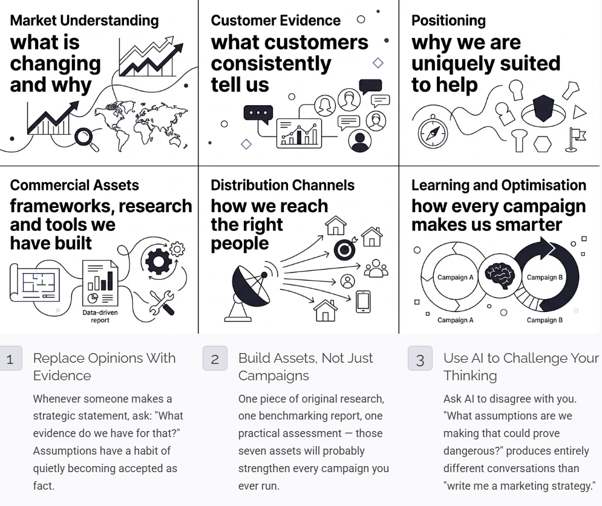
Where do we have evidence?
Where do we simply have opinion?
Those questions rarely produce instant answers.
They do produce much better discussions.
And better discussions usually lead to better decisions.
One of the biggest shifts in my own thinking over the past few years has been around the role of evidence.
When I first started in business, experience counted for almost everything.
If someone had spent twenty years in an industry, you naturally assumed they understood it.
Experience still matters enormously. But experience without reflection can become surprisingly dangerous.
I've met organisations who've been making the same mistake for fifteen years. Experience didn't help them. It simply made the mistake more familiar.
Evidence changes that. It forces us to challenge our own assumptions. It asks awkward questions.
It occasionally proves us wrong. And that's healthy.
Some of the best strategic decisions I've ever made began with discovering that something I believed to be true... wasn't.
Those moments can be slightly uncomfortable.
They're also incredibly valuable.
Because once an assumption becomes visible, it becomes testable.
And once it's testable, it becomes improvable.
This is where I think leadership teams sometimes underestimate the value of curiosity.
Curiosity isn't simply a personality trait.
It's a commercial capability.
Curious organisations ask better questions.
They interview customers more often.
They analyse lost opportunities rather than filing them away.
They pay attention to emerging trends before those trends become headlines.
Most importantly, they remain open to changing their minds when the evidence points in a different direction.
I've never met a genuinely innovative business that wasn't intensely curious about its customers.
Equally, I've rarely met a business that had stopped growing without also noticing that curiosity had gradually been replaced by certainty.
"We already know our market."
"Our customers always buy this way."
"We've tried that before."
They're perfectly understandable statements. They're also surprisingly dangerous.
Markets don't stand still. Neither do customers. So why should our understanding?
So where does all of this leave an SME that's trying to build a better growth strategy?
Probably somewhere much simpler than you expected.
Don't begin with channels.
Don't begin with software.
Don't begin with AI.
Begin with understanding.
Understand your market better than your competitors.
Understand your customers better than you did six months ago.
Understand which parts of your commercial thinking are supported by evidence and which parts are still assumptions waiting to be tested.
Everything else becomes easier. Your messaging improves because your understanding improves. Your outreach feels more relevant because it reflects real customer concerns. Your content becomes more useful because it's grounded in genuine observations rather than marketing opinion.
And your sales conversations become more productive because prospects arrive already recognising that you understand the world they're operating in.
That's a much stronger place from which to grow.
Looking back over everything we've explored so far, one idea keeps resurfacing.
The businesses pulling away from the competition aren't necessarily doing more. They're doing more of the right things. They've become disciplined about understanding before acting, researching before promoting and learning before scaling.
It isn't a glamorous approach. You won't see many LinkedIn posts promising that curiosity is the secret to growth.
But I suspect it's considerably closer to the truth than most of the shortcuts currently being marketed. Because businesses rarely outperform their understanding for very long.
Eventually, the market catches up.
The organisations that continue growing are usually the ones that keep learning. Which brings us to the final part of this paper.
We've explored the evidence, challenged a few assumptions and examined what high-growth businesses appear to do differently. The only question that remains is perhaps the most important one of all.
What should an SME actually do next?
Recommended Reading
Richard Rumelt – Good Strategy Bad Strategy
https://www.hachettebookgroup.com/titles/richard-rumelt/good-strategy-bad-strategy/9780307886231/ - One of the clearest books ever written on identifying the real challenge before deciding how to respond.
Roger L. Martin – Playing to Win: How Strategy Really Works https://rogerlmartin.com/
An excellent companion for leadership teams looking to make better strategic choices rather than simply increasing marketing activity.
Chapter 7
So, What Should SMEs Do Next?
Whenever I finish presenting research like this to a leadership team, somebody almost always asks the same question.
"This all makes sense, but what do we actually do on Monday morning?"
I like that question because it's grounded in reality.
Business owners don't have the luxury of disappearing into a strategy retreat for six months while they redesign their commercial model. Customers still need looking after. Sales targets still exist. Payroll still arrives at the end of the month. Strategy has to fit around the realities of running a business, not replace them.
The temptation at this point is to produce a checklist.
Ten things to do this week. Twenty questions to answer. Five AI tools to try. Three books to read.
If I'm honest, I think that would completely undermine everything we've discussed throughout this paper.
Growth has never been the result of following somebody else's checklist.
It's usually the result of asking better questions than your competitors and then having the discipline to act on the answers.
So rather than giving you another framework, I'd like to leave you with a few observations that I think have become increasingly important as I've worked with businesses over the years.
The first is that most SMEs already know far more than they realise.
That probably sounds like a strange thing to say after spending an entire paper talking about research and learning, but hear me out.
Whenever I start working with a new client, I'm often struck by just how much knowledge already exists inside the business. The sales team understand which objections appear in almost every meeting. Customer Success know exactly where clients struggle during implementation. Directors have usually developed an instinct for spotting good opportunities from bad ones. Marketing have accumulated years of campaign data, customer feedback and market observations.
The problem isn't a lack of knowledge.
The problem is that it exists in pieces.
It's scattered across departments, buried inside CRMs, hidden in notebooks, sitting in meeting minutes or locked inside the experience of individuals.
Nobody has joined the dots.
That's one of the reasons strategy often feels difficult.
You're not starting from scratch. You're trying to assemble a jigsaw where all the pieces are in different rooms.
One of the biggest improvements an SME can make is simply creating regular opportunities for those conversations to happen.
Not another reporting meeting. A learning meeting.
There's an important difference. Reporting meetings tend to focus on what happened. Learning meetings focus on why it happened.
That one change alters the quality of the discussion almost immediately.
Here's another thing I've noticed.
Businesses often become so focused on attracting new customers that they stop listening to the ones they've already got.
If I could only choose one source of marketing intelligence, it wouldn't be Google Analytics. It wouldn't be LinkedIn. It wouldn't even be AI.
It would be customers.
Not because customers always know the answer. They don't. But because they tell you how they think.
Listen carefully to enough customer conversations and you begin hearing the same language appearing over and over again. The same frustrations. The same aspirations. The same concerns. Occasionally you'll hear somebody describe a problem in a way that completely changes how you've been talking about it for years.
Those moments are gold dust. They rarely happen in boardrooms. They almost always happen in conversations.
I've often thought that businesses spend thousands of pounds researching markets whilst quietly overlooking the richest source of insight they already have.
Their existing customers.
Perhaps that's why I remain slightly sceptical whenever somebody asks me whether AI will replace marketers.
It's the wrong question.
The better question is whether marketers will spend more time behaving like researchers. That's where I think the opportunity lies.
Imagine removing all the repetitive work that currently fills a marketing team's week.
The formatting.
The scheduling.
The first drafts.
The data collection.
The reporting.
What would you do with the time you've just created?
My hope is that businesses won't simply use it to produce more content.
I hope they'll use it to think. To spend another afternoon with customers. To interview prospects they didn't win. To analyse changing buying behaviour.
And to challenge assumptions, to read, and even to write.
Oh, and to connect those ideas that previously remained disconnected.
Those activities don't always produce immediate results. But they do tend to produce better decisions.
And better decisions have a habit of improving almost everything else.
If there's one habit I'd encourage every leadership team to develop, it's becoming slightly more suspicious of certainty.
That may sound like an odd recommendation, because confidence is important.
But good leadership requires conviction.
Businesses can't endlessly second-guess every decision, but at the same time, certainty has a habit of becoming dangerous.
How many times have you heard a prospect client say "We know our market."
"Our customers only buy on price." Or "Email doesn't work anymore." Or "We've already tried that."
I've heard every one of those statements countless times.
And sometimes they're true. Surprisingly often they aren't.
One of the healthiest things evidence does is force us to revisit assumptions we've quietly stopped questioning. That's sightly uncomfortable.
It's also where many of the biggest commercial breakthroughs begin. Because once an assumption is challenged, new possibilities emerge.
Perhaps the market has changed. Perhaps customers now value something different. Perhaps your competitors have moved the conversation somewhere else without you noticing. Perhaps the problem wasn't the market at all.
Perhaps it was the story you'd been telling yourself about the market.
Those are difficult conversations. They're usually worthwhile ones though.
There's another lesson that's stayed with me throughout this research.
The businesses that continue growing rarely appear to be chasing every opportunity. In fact, they're often doing the opposite. They're becoming increasingly selective.
They understand who they work best with. Which problems they're genuinely good at solving, and where they add the greatest value.
Equally importantly, they recognise the work they shouldn't be pursuing.
And that takes balls – to turn down business
It's also one of the reasons their marketing becomes more effective.
When you know exactly who you're trying to help, everything becomes easier.
Your messaging becomes clearer. Your content feels more relevant. Your outreach sounds more natural because you're no longer trying to appeal to everybody.
You're simply having better conversations with the people who are most likely to benefit from what you do.
I've never been convinced that growth comes from speaking to more people. Although I have done it of course. Spammed out 50,000 emails when I already knw=ew that there were 5000 relevant prospects in there a best.
More often, it comes from becoming significantly more relevant to the right people.
So, if somebody asked me to summarise everything we've explored throughout this paper into one piece of advice, I think it would be this.
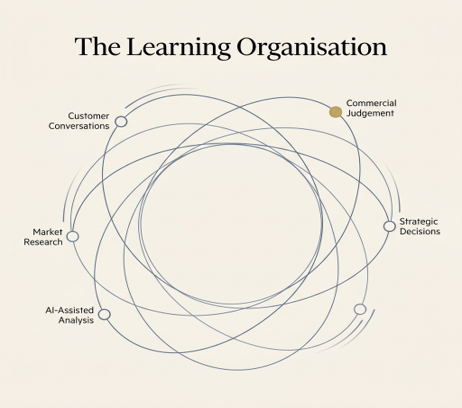
Stop trying to become a better marketing organisation. Instead, become a better learning organisation.
Marketing will improve as a consequence.
The emails will become more relevant because your understanding has improved.
The LinkedIn content will become more interesting because you've uncovered genuinely useful observations.
Your proposals will become more persuasive because they're grounded in evidence rather than assumption.
Even your sales conversations will change because prospects arrive already recognising that you've spent time understanding the world they're operating in.
Marketing stops feeling like promotion, and it starts feeling like the natural outcome of good thinking.
Personally, I think that's a much more enjoyable way to build a business.
As we've worked through this paper, we've explored why growth has become more difficult, why some SMEs continue pulling away from the competition and why technology, although enormously important, rarely provides a sustainable competitive advantage on its own.
We've looked at research, behavioural science, AI, customer understanding and commercial decision-making from several different angles, yet have you noticed, that we've kept arriving at remarkably similar conclusions.
Businesses don't usually outperform the quality of their understanding.
Eventually, the market catches up.
The organisations that continue to grow are the ones that keep learning after everyone else believes they've already learned enough.
Perhaps that's always been true.
The only difference today is that the businesses prepared to do it are beginning to pull away much more quickly than ever before.
Recommended Reading
Jim Collins – Good to Great
https://www.jimcollins.com/
A timeless study into why disciplined organisations consistently outperform competitors over the long term, not through dramatic breakthroughs but through sustained improvements in thinking and execution.
Ethan Mollick – Co-Intelligence: Living and Working with AI
https://www.oneusefulthing.org/
A refreshingly balanced exploration of how AI should be viewed as a collaborator that enhances human judgement rather than replacing it, closely reflecting the philosophy discussed throughout this paper.
Chapter 8
Looking Ahead:
The Future Belongs to Businesses That Learn Faster Than They Market
When I first started putting this paper together, I thought I was writing about marketing.
Somewhere along the way I realised I wasn't. I was writing about business.
Marketing simply happened to be the lens through which we were examining it.
If you've stayed with me this far, you've probably noticed the same thing. We started by asking why some SMEs continue to grow whilst others seem to be working harder than ever for increasingly modest returns. We looked at behavioural science, buyer psychology, AI, email, LinkedIn, positioning and commercial strategy. Yet every road eventually led back to exactly the same place.
Understanding.
Not understanding in the academic sense. Not another research report that ends up sitting on a shelf gathering dust. I mean the practical understanding that comes from talking to customers, paying attention to markets, challenging your own assumptions and gradually building a picture of how the world is changing around you.
The more I think about it, the more I believe that's what modern marketing is really becoming.
Not a communications function. But, an understanding function.
One of the reasons I remain optimistic about the future is because I don't think technology is replacing the things that matter most.
It's replacing the things that matter least.
Think about how much time most marketing teams have traditionally spent formatting documents, resizing graphics, rewriting headlines, updating presentations, producing reports, moving data between systems and creating first drafts of content.
Useful work? Absolutely.
The best use of experienced people? Probably not.
If AI removes much of that effort, something rather interesting happens. It gives us time back. So, the obvious question is - what will we choose to do with it.
We could simply produce more content. Judging by LinkedIn over the past couple of years, plenty of businesses have already chosen that route.
Or we could spend more time understanding customers than our competitors do.
Personally, I think the second option is where the real opportunity lies.
There's another reason I think this matters.
For years we've talked about competitive advantage as though it comes from products, pricing or technology.
Yes, sometimes it does. But, increasingly, I think competitive advantage comes from seeing something before everyone else sees it.
Recognising a change in buyer behaviour before it appears in the industry press.
Spotting a recurring frustration that competitors are still ignoring.
Joining together lots of seemingly unrelated conversations until a pattern begins to emerge.
Those moments rarely arrive because somebody bought another piece of software.
They arrive because somebody was paying attention.
I've lost count of the number of times a throwaway comment during a customer meeting has eventually become the foundation of a completely new service or proposition. At the time, it didn't feel particularly significant. It was simply an interesting observation.
Six months later it turned out to be the beginning of something much bigger.
That's one of the reasons I still enjoy this work after so many years.
You never quite know which conversation is going to change the way you think.
I sometimes wonder whether we've accidentally created an unrealistic picture of what successful businesses actually look like.
We imagine leadership teams making bold strategic decisions, launching major initiatives and transforming organisations through moments of inspiration.
In reality, most of the successful businesses I've worked with don't operate like that at all. They're simply a little bit better this month than they were last month.
They've improved one proposal. Refined one framework. Published one useful article. Interviewed another customer. Updated a piece of research. Tested a different idea.
None of those things make headlines.
Collectively they become incredibly difficult to compete with.
Progress, in my experience, is rarely dramatic.
It's usually cumulative.
Just think of how High-performing strategy works at a basic level. Collective people working on a range of problems, each committing to a part of the solution, meeting regularly to discuss progress.
There's a phrase that's stayed with me for a while now..
Businesses don't outperform the quality of their understanding for very long.
At first, you might.
A strong reputation can carry you.
A loyal customer base helps enormously.
A good product creates momentum.
Eventually though, markets move. Customers change. Competitors evolve.
And new technology appears.
The businesses that continue growing aren't necessarily the fastest to react.
But I bet that they are amongst the first to notice.
That's a subtle but important distinction. You can't respond to something you haven't recognised.
And understanding always needs to come before action.
If I could leave you with one practical recommendation, it wouldn't be to rewrite your website or launch another campaign.
I'd encourage you to become slightly more curious.
Spend a little more time talking to customers without trying to sell them anything.
Ask prospects why they nearly didn't buy.
Ask former customers why they left.
Ask your sales team which conversations are changing.
Ask your customer success team which questions keep appearing.
Ask your leadership team which assumptions they haven't challenged for years.
The answers probably won't transform your business overnight.
They will almost certainly improve your next decision though.
Then the one after that. And then the one after that.
That's how sustainable growth usually happens. Not through one brilliant idea. But. through hundreds of slightly better decisions made over a long period of time.
Perhaps that's why I've become increasingly uncomfortable with the phrase growth hacking.
It implies there's a shortcut, or a clever trick that we are missing. A hidden tactic that everyone else has somehow overlooked.
I've been around long enough to know those moments rarely last.
Markets nearly always catch up. And I nearly always caught the tail end of those short term opportunities - at best
The things is, algorithms change, (especially in email), competitors copy, and the advantage disappears.
Understanding doesn't behave like that. It accumulates and deepens, and then compounds.
That's considerably harder to replicate.
As we've explored throughout this paper, AI will undoubtedly reshape the marketing profession over the coming decade.
Some jobs will change dramatically. New disciplines will emerge, and many routine activities will become increasingly automated.
I don't see that as a threat. I see it as an opportunity to return marketing to what I think it was always supposed to be. Understanding people and understanding markets.
Helping businesses make better decisions. Creating genuine value before asking for attention.
Technology should help us do those things more effectively and it shouldn't distract us from doing them at all.
I'd like to finish with the same question that started this research.
Why do some SMEs continue to grow whilst others struggle to generate new opportunities?
After everything we've explored, I don't think there's a single answer.
There are dozens.
Better positioning.
Clearer messaging.
More useful commercial assets.
Greater customer understanding.
Evidence rather than assumption.
AI used intelligently.
A commitment to continuous learning.
None of those things, on their own, creates sustainable growth.
Together, they begin to look remarkably like the businesses that consistently outperform their competitors.
Which perhaps explains why the companies pulling away from the market don't appear to have discovered a secret. They've simply built a better way of learning.
And once a business becomes better at learning than its competitors, better marketing tends to follow naturally.
So does better sales. Better products. Better customer experiences and Better decisions.
In the end, this paper wasn't really about marketing after all.
It was about building a business that never stops getting smarter.
I suspect that's an advantage that will still matter long after today's technology has been replaced by tomorrow's.
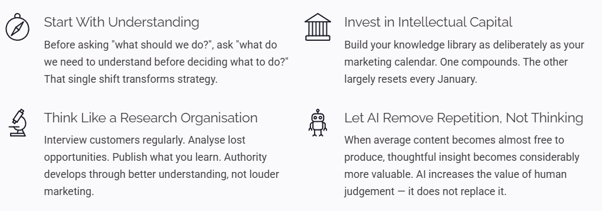
Recommended Reading
Morgan Housel – Same As Ever: Timeless Lessons on Risk, Opportunity and Living a Good Life
https://www.morganhousel.com/
A thoughtful reminder that whilst technology and markets evolve rapidly, many of the underlying behaviours that shape human decision-making remain remarkably consistent.
Byron Sharp – How Brands Grow
https://www.howbrandsgrow.com/
One of the most influential modern books on marketing effectiveness, challenging many accepted assumptions and reinforcing the importance of evidence over opinion.
About the Author
By the time you've reached this point, you'll probably have realised that this paper wasn't written to demonstrate how much the author knows.
It was written to encourage you to think a little differently about how growth actually happens.
Over the last thirty years I've had the privilege of building businesses, advising leadership teams and working alongside organisations ranging from ambitious start-ups to established SMEs looking for their next phase of growth. Those experiences have taken me through recruitment, technology, marketing, SaaS and commercial consultancy, but one theme has remained remarkably consistent throughout.
Businesses rarely fail because they don't work hard enough.
More often, they struggle because they're solving yesterday's problems with yesterday's thinking.
That observation has shaped much of my career.
I've always been fascinated by the difference between businesses that appear to create momentum almost effortlessly and those that seem permanently trapped in a cycle of activity without ever quite achieving the results they deserve. It isn't usually because one team is more intelligent than another, or because one company has access to some secret marketing tactic. More often than not, it's because one organisation has become better at understanding what's really happening in its market and then has the discipline to act on that understanding.
That's the thinking that sits behind everything I do today.
My work combines commercial strategy, behavioural science, market research and modern AI to help businesses make better decisions before they make bigger investments. Sometimes that means helping a leadership team rethink its market positioning. Sometimes it means redesigning a growth strategy, improving customer acquisition or aligning sales and marketing around a clearer commercial direction. Increasingly, it involves helping organisations understand how artificial intelligence can strengthen human judgement rather than replacing it.
I'm also the founder of BookMyDemos, a specialist B2B demand generation consultancy, and the creator of the Marketing Intelligence Engine (MIE), an ongoing research programme exploring how organisations can capture, organise and apply commercial knowledge more effectively. Although the technology behind that work continues to evolve, the underlying philosophy is deliberately simple.
Businesses should become progressively more intelligent every time they interact with their market.
Every customer conversation should teach us something.
Every campaign should leave us with more understanding than we had before it started.
Every piece of research should strengthen the next strategic decision.
The organisations that consistently do those things don't just become better marketers.
They become better businesses.
If this paper has encouraged you to question a few assumptions, challenge some accepted wisdom or simply become a little more curious about the markets you serve, then it has achieved exactly what I hoped it would.
After all, the objective was never to convince you that I have all the answers.
It was to encourage you to keep asking better questions.
Two Ways We Can Work Together
Every business reaches a point where fresh perspective becomes valuable.
Sometimes the challenge isn't generating more opportunities. It's understanding why opportunities have slowed down in the first place. At other times, the strategy is already clear and the business simply needs an experienced team to help execute it consistently.
Over the years I've found that almost every engagement falls into one of those two categories, which is why I now work with organisations in two distinct ways.
Fractional Growth Strategy & Commercial Advisory
This is for businesses that want to strengthen the thinking before they increase the activity.
Perhaps growth has plateaued and you're not entirely sure why. Maybe your sales and marketing teams are working hard but not always in the same direction. You might have ambitious plans for the next three to five years but want an independent perspective before making significant investments in people, technology or new markets.
My role is to work alongside founders, managing directors and leadership teams as a strategic partner, helping them understand where the greatest commercial opportunities genuinely exist and where effort is currently being wasted.
That work often includes market research, customer insight, competitor analysis, commercial positioning, value proposition development, AI strategy, sales and marketing alignment, thought leadership and the development of practical frameworks that help the organisation make better decisions long after the consultancy has finished.
I'm not particularly interested in producing reports that sit on a shelf.
I'd much rather leave a business thinking differently than simply documenting what it already knew.
Practical Demand Generation & Outbound Growth
Some organisations already know where they're going.
They've done the strategic thinking.
They understand their market.
What they need is a consistent, evidence-based way of creating new commercial conversations.
That's where BookMyDemos comes in.
Rather than treating outbound marketing as a volume exercise, we build campaigns around market understanding, original research and genuinely useful commercial assets. Email and LinkedIn become the channels through which those ideas are shared, not the strategy itself.
Our work combines deep prospect research, ideal customer profiling, AI-assisted market analysis, educational content, commercial frameworks and carefully managed outreach campaigns designed to create conversations rather than simply generate clicks.
The objective isn't to fill diaries with meetings.
It's to create better conversations with businesses that are already likely to benefit from what you do.
Those two things sound similar.
In practice, they're worlds apart.
One Final Thought
There's a quote I've returned to repeatedly whilst writing this paper.
Not because it's particularly clever, but because it captures what I believe modern marketing is becoming.
Marketing expertise should no longer be limited by the availability of experts or by budgetary constraints. Artificial intelligence gives us the opportunity to make great commercial thinking more accessible than ever before. Our responsibility is to ensure that technology amplifies human judgement rather than replacing it.
Perhaps that's the real opportunity facing SMEs over the next decade.
Not to outspend larger competitors.
Not to out-automate them.
But to outlearn them.
Because businesses that continue learning long after everyone else believes they've already learned enough will almost always discover opportunities that others simply never see.
And in my experience, that's where sustainable growth has always come from.
Sources, Research & Further Reading
Section 1. Primary Research and Internal Sources
The following proprietary research, frameworks and knowledge bases were developed by Mark Stephens and form the primary intellectual foundation for this publication.
Marketing Intelligence Engine (MIE)
Marketing Intelligence Engine (MIE) Master Knowledge Base
Marketing Intelligence Engine Design Principles
Marketing Intelligence Engine Manifesto
MIE Experience Blueprint
MIE Commercial Decision Architecture
MIE Behavioural Decision Framework
MIE Market Reasoning Framework
MIE AI Co-Pilot Framework
MIE Learning & Knowledge Architecture
These documents provided the conceptual framework for evidence-based marketing, organisational learning, AI-assisted strategy and commercial knowledge management.
BookMyDemos Research Library
The Secret Sauce to Successful Cold Outreach
Email & LinkedIn Outreach Framework
Deliverability Framework
B2B Outreach Psychology Library
Outbound Marketing Playbook
Growth Intelligence Framework
Growth Intelligence Review Methodology
Commercial Psychology Playbook
Marketing Intelligence Knowledge Base
GTM Strategy Framework
These documents informed the practical recommendations on outbound strategy, educational marketing, asset-led outreach and evidence-based campaign design.
360Pro Research
AI CRM Strategy
Organisational Knowledge Architecture
Commercial Intelligence Framework
Growth Intelligence Assessment
AI Marketing Operating Model
Marketing Knowledge Repository Framework
These sources informed the discussion around organisational memory, knowledge management and AI-supported commercial decision-making.
Section 2. Books and Academic Sources
Strategy
Good Strategy Bad Strategy
Richard Rumelt
Understanding the difference between strategy and tactics.
Playing to Win
Roger L. Martin & A.G. Lafley
Strategic choice and competitive positioning.
Blue Ocean Strategy
W. Chan Kim & Renée Mauborgne
Market creation rather than market competition.
Seeing Around Corners
Rita McGrath
Strategic inflection points and anticipating market change.
Marketing
How Brands Grow
Byron Sharp
Evidence-based marketing effectiveness.
Obviously Awesome
April Dunford
Positioning and differentiation.
This Is Marketing
Seth Godin
Creating value before selling.
Positioning
Al Ries & Jack Trout
Market positioning and competitive perception.
Sales
The Challenger Sale
Matthew Dixon & Brent Adamson
Insight-led selling.
SPIN Selling
Neil Rackham
Consultative sales methodology.
Building a StoryBrand
Donald Miller
Clear communication and customer-centred messaging.
Behavioural Science
Thinking, Fast and Slow
Daniel Kahneman
Behavioural economics and decision-making.
Influence
Robert Cialdini
Persuasion psychology.
Predictably Irrational
Dan Ariely
Behavioural economics.
Nudge
Richard Thaler & Cass Sunstein
Choice architecture.
Learning Organisations & Knowledge
The Fifth Discipline
Peter Senge
Learning organisations.
The Knowledge-Creating Company
Nonaka & Takeuchi
Knowledge creation.
Intellectual Capital
Thomas Stewart
Knowledge as competitive advantage.
AI & Future of Work
Co-Intelligence
Ethan Mollick
Human-AI collaboration.
All In on AI
Thomas Davenport & Nitin Mittal
AI adoption in organisations.
Section 3. Academic Literature and Research
The thinking presented throughout this publication also draws upon established work in:
Marketing Science
Behavioural Economics
Decision Science
Organisational Learning
Market Intelligence
Competitive Intelligence
Knowledge Management
Marketing Analytics
Customer Psychology
Commercial Strategy
Relevant background sources include work by the Ehrenberg-Bass Institute for Marketing Science on marketing effectiveness, alongside literature on marketing intelligence, market intelligence and knowledge management.
Research Methodology
This publication was produced using a mixed-method evidence synthesis approach, combining:
Over thirty years of commercial consulting and entrepreneurial experience.
Proprietary research and strategic frameworks developed through the Marketing Intelligence Engine (MIE), BookMyDemos and 360Pro programmes.
Established behavioural science, marketing and strategy literature.
Contemporary thinking on AI-assisted marketing, market intelligence and organisational learning.
Practical observations from hundreds of SME strategy engagements across recruitment, technology, SaaS and professional services.
Rather than attempting to introduce a new academic theory, the objective has been to synthesise established evidence with practical commercial experience into a framework that SME leaders can readily apply to improve strategic decision-making and sustainable growth.


